

The fight to prevent bone fractures and their potentially serious consequences has made considerable progress in recent years
By Wendy Haaf
When Barbara slipped on an icy sidewalk one January morning, the 55-year-old was more irritated than alarmed on discovering that she’d broken her wrist. She needed a cast but didn’t really think beyond what a nuisance it would be navigating life one-handed for the next several weeks. However, when you’re 40 or older, suffering a fracture as a result of falling from standing height, even on pavement or ice, should be considered a medical emergency on par with a heart attack, according to Dr. Kristin K. Clemens, medical director of the Osteoporosis and Bone Disease Program at St. Joseph’s Health Care London and an associate professor at Western University’s Schulich School of Medicine & Dentistry in London, Ont.
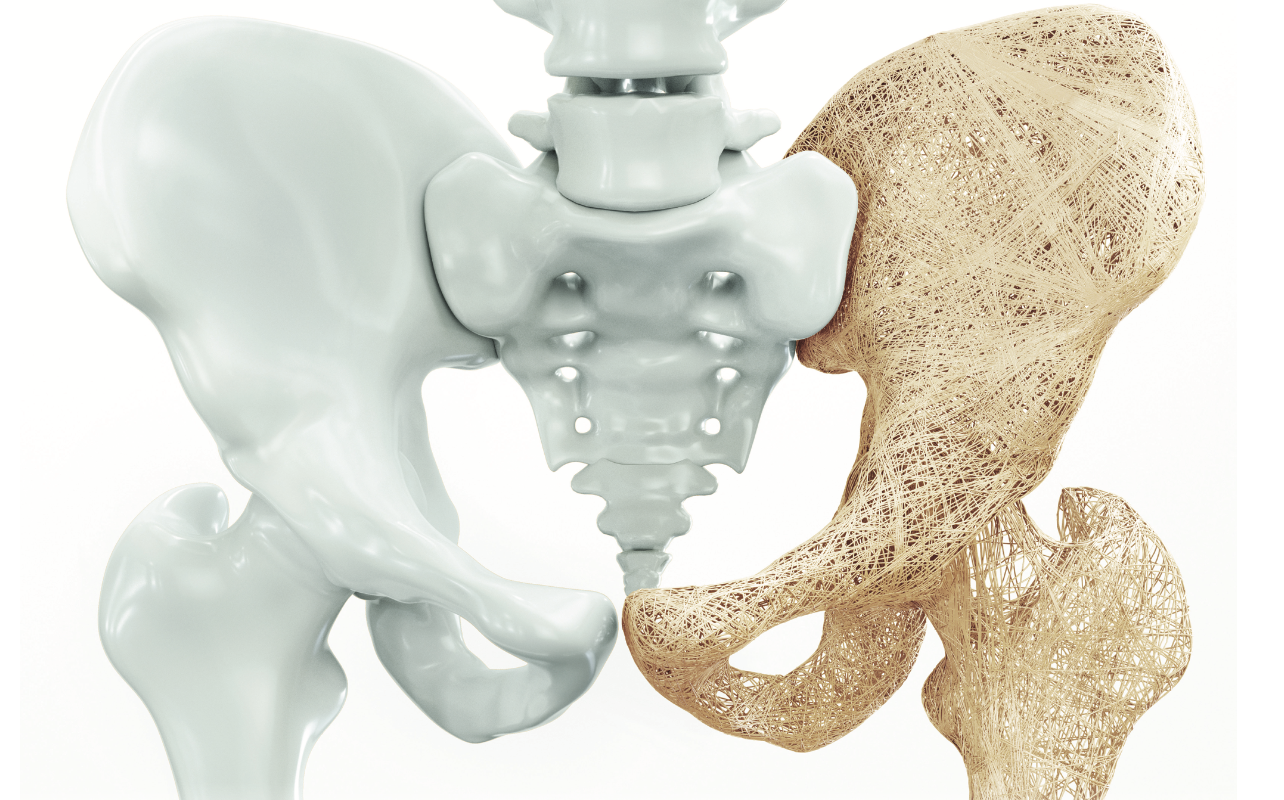
Since healthy bones typically don’t break as a result of such low-energy trauma, the underlying cause is very likely to be osteoporosis, a disease that saps the strength from bone, rendering it brittle and prone to fracture. In fact, 80 per cent of all fractures in people 50 or older are due to osteoporosis, and one in three women and one in five men will experience an osteoporotic fracture in their lifetime.
“And people who’ve had a fracture are at very high risk of having another fracture soon after—it’s called imminent risk,” Clemens says. “Those fractures shouldn’t be just brushed aside by the patient or health-care provider. They’re a clue that the person needs to be seen and started on treatment right away. We wouldn’t leave a heart attack untreated, and it’s the same with the fracture.”
One of the major aims of treatment is to prevent hip fractures, which carry a high risk of post-operative complications, long-term disability, and even death. According to Osteoporosis Canada, 22 per cent of women and 33 per cent of men who suffer a hip fracture will die with- in one year, and one in three hip-fracture patients will re-fracture within the following year.
Fortunately, we now have many medications that can restore a more normal balance between the tearing down and rebuilding that our skeleton continuously cycles through. (This goes awry in osteoporosis, as the cells that demolish old bone outpace those that rebuild it.) Let’s review some of the developments that have occurred in the approach to managing osteoporosis since Good Times last published a feature on the topic in 2020.
Increasingly Individualized Treatment
One of the themes of the most recent (2023) update of the Canadian clinical-practice guidelines for the management of osteoporosis and fracture prevention is “a focus on treatment individualization,” Clemens says. This includes a change to the treatment recommendations “for people who are at higher risk of fracture, and we would define those as people who’ve had vertebral compression fracture and really low bone density.”
In a vertebral compression fracture, one of these bones collapses or squashes under pressure. An estimated two-thirds of such fractures cause no immediate symptoms. The revised guidelines “suggest that we reach for anabolic medications in this group of patients,” Clemens says. “Anabolic medications are our bone-building medications.” Unlike older bisphosphonates and denosumab (Prolia), which only slow bone loss, anabolic medications “actually allow us to build bone at the spine.”
One of the newer anabolic medications, called romosozumab (Evenity), is “a once-a-month injection that’s provided to patients for one year,” Clemens says, adding that of all the osteoporosis medications currently available in Canada, it’s the most powerful. “It builds bone up at the spine and at the hip,” she says. “It offers close to a 75 per cent reduction in fracture risk. We know that using this medication in people who have never used any osteoporosis medications before is most potent. So what we’re trying to do—what the guidelines are trying to do—is to get the word out that we really want to see these people who are at high risk and get them treated urgently. If we can access the anabolic medications, then that would be the treatment of choice.”
While bisphosphonates are still recommended as first-line treatment for those at moderate risk for fracture, “as previous guidelines suggested, denosumab is useful for those who might not be able to tolerate some of the oral bisphosphonates,” Clemens explains.
Denosumab is a biologic—meaning it’s produced by living cells—that’s injected under the skin, usually once every six months. Importantly, patients should know that stopping the medication suddenly can result in rapid bone loss, which can be prevented by switching to a different drug for a period of time.
A Growing Roster of Biosimilars
Biosimilars are to biologic medications what generic drugs are to brand-name medications made from chemicals. “We’re seeing biosimilars more and more commonly,” Clemens says. “They’re as effective as the brand names, but they’re much more accessible to Canadians because the cost is about 20 to 40 per cent less. So we can treat people who perhaps didn’t have the ability to use biologic treatments before.”
New counterparts of two bone-building medications are now available in Canada— generic versions of teriparatide (Forteo is the original) and denosumab.
Tiered Exercise Recommendations
While the scientific evidence supporting different types of exercise for reducing fracture risk hasn’t changed a great deal, “our approach to developing the recommendations shifted,” says Lora Giangregorio, professor and Tier 1 Canada Research Chair in Bone Health and Exercise Science at the University of Waterloo in Waterloo, Ont., and one of the co-authors of the 2023 guidelines. She says she believes that people found the earlier version “a bit overwhelming, so we tried to prioritize the recommendations.”
The highest priority is preventing falls and fractures. “If that’s your goal, where’s the most bang for your buck? The strongest evidence we have is for either training programs that challenge balance, gait, coordination, and physical functioning or multi-component programs that combine, say, resistance training with balance training,” Giangregorio says. “We have really high-certainty evidence that if we can incorporate these types of exercise, we can prevent falls.”
She stresses that to improve your balance, exercises should challenge it—meaning you’ll feel unstable—and require shifting your weight. Examples include standing next to a low step on one foot while repeatedly tapping the toes of your other foot on the step, catching and throwing a ball, and making quick direction changes while walking.
“So the first layer is balance and functional gait training for everyone, and we recommend that the second layer be strength training for everyone,” Giangregorio says. In addition to helping maintain muscle mass and enhancing stability, strength or resistance training “can affect mortality and cardiovascular health and frailty,” she says.
“Strength training will improve your body composition. It will make you stronger, it will make you faster, and it will improve your cardiovascular fitness.”
If you’re at higher risk for fracture, Giangregorio suggests that, if possible, you seek advice from exercise or rehabilitation professionals who are knowledgeable about osteoporosis. These practitioners can help determine whether you need to modify certain movements to maximize safety and minimize risk for fracture.
And there’s a third layer. “People who really value improving their bone-mineral density [BMD] may want to incorporate moderate- to high-impact exercise,” Giangregorio says. “It’s not for everyone—for some people, the risks may outweigh the benefits, perhaps because they don’t have good mobility or they are at high fall risk or have already had multiple vertebral fractures and impact poses an extra risk for them.” Similarly, “for people who want to participate in impact exercise or other types of exercise for particular health benefits or enjoyment, we encourage them to do it—as long as it’s safe for them or it can be modified for safety.” You can find a PDF showing specific exercises and a video series on exercise and osteoporosis online.
Unproven Products and Services
You may have come across ads for weighted vests and wondered whether wearing one would be an easy way to help preserve your bone strength. Unfortunately, “the evidence supporting the use of weighted vests for bone-mineral density changes is not very good,” Giangregorio says.
“In fact, a trial that just came out showed no benefit.” (She gives a more detailed rundown in a three-minute animated video on her YouTube channel.) While ads and influencers encourage people to wear these vests—which can typically add between five and 20 per cent of your body weight—during walks or daily activities, Giangregorio says: “I don’t think that’s a good strategy if your goal is to increase bone-mineral density through exercise training. I just don’t think it’s going to move the dial for most people.”
However, she adds, these garments may be helpful for a narrow segment of the population. “If someone wants to add weight to a resistance-training exercise and it’s not feasible for them to grip a weight or use the machines, then it can add resistance,” she says. “For example, we had someone in one of our studies who couldn’t get out of a chair without using the arms for support when she started the study. Maybe in the beginning, a weighted vest could have helped her.” But that same woman eventually graduated to doing a type of deep squat with a 30-pound weight. A vest “doesn’t allow for as much progression as other equipment,” Giangregorio stresses.
A chain of wellness clinics called Osteostrong advertises a “bone density circuit” of brief, high-intensity, low-impact exercises using machines. Sound promising? Not so much, according to a group of experts who reviewed the evidence on Osteostrong for Osteoporosis Canada, including a 2025 article published in the Journal of Clinical Endocrinology and Metabolism. In a point-by-point critique of the article, the experts explained how it does not meet the most basic standards for research reporting. Just one of the gaping flaws: participants chose whether to participate in the Osteostrong group or not, as opposed to being randomly assigned to that group or a control group.
The problem with this is that people who were inclined to take part may have been healthier or more fit overall than those who didn’t wish to participate. In a video for her YouTube channel, Giangregorio lays out why: “From what we can tell, it is a very low-quality study.” She notes that “scientists globally have made the journal editors aware of our concerns about this paper and have called for its retraction.”
The statement from Osteoporosis Canada also points out problems with previous papers, which, among other things, “are limited to observational studies with small sample sizes that are at high risk of bias and are industry funded.” Furthermore, in the one randomized controlled trial that “compared devices like those used in Osteostrong to a high-intensity strength and impact exercise program… the devices did not increase bone-mineral density compared to high-intensity strength and impact exercise.”
Revised Screening Recommendations
The recommendations concerning screening for osteoporosis—usually by measuring BMD with a type of X-ray called a DXA scan—have been tweaked somewhat so they’re more tailored to individual risk.
It’s recommended that at age 50 (or at menopause, if it’s earlier), everyone undergo a fracture-risk assessment, which involves identifying the following risk factors: previous fracture after age 40; the use of glucocorticoids (steroid hormones such as prednisone) for more than three months; two or more falls in the previous year; a parent who fractured a hip; medications that cause bone loss; medical conditions such as celiac disease that inhibit the absorption of nutrients; current smoking; consuming three or more alcoholic drinks a day; a body mass index below 20 kg/m2 (kilograms divided by height in metres squared); and the suspicion of possible vertebral fractures based on characteristics such as loss of height. You can take a self-test to gauge your fracture risk at osteoporosis.ca.
It’s recommended that people with a previous fracture, or two or more other risk factors, have BMD testing between the ages of 50 and 64 and that those with just one risk factor have it done at 65. For those with none of these risk factors, it’s now recommended “that pretty much everyone over 70 should be screened,” Clemens says. She urges that “people make sure they talk to their doctors about bone health and whether they’re a candidate for screening. That way, we can detect osteoporosis and get people on good treatment early to prevent fracture in the first place.”