


By Marie-Julie Gagnon
Cruising is becoming more popular every year. Between 2023 and 2024, the total number of passengers around the world grew by nine per cent, and the same growth was projected for 2025. But not all cruisers set sail on huge floating cities offering a wide range of on-board activities, and those looking for something on a smaller scale now have lots of options.
When Royal Caribbean’s Icon of the Seas made its maiden voyage in January 2024, it was the world’s largest cruise ship (its sister ship, Star of the Seas, entered service in 2025), with 2,350 crew members and a maximum capacity of 7,600 passengers; many fans applauded the arrival of this “floating temple of fun.” But others—and I’m one of them—saw the flashy ship as embodying their worst nightmare.
Spend day after day with thousands of strangers in a confined space that’s home to the largest water park on the ocean, including seven swimming pools and six waterslides? No, thanks!
And yet, I love sailing. Every time I go, I experience a great sense of freedom. Discovering a place by sea gives you a totally different perspective. And seeing several countries without having to tote your luggage from place to place is a real perk. Still, my enjoyment is inversely proportional to the number of bells and whistles the ship offers: the more there are, the less I like it.
What interests me isn’t onboard casinos, skating rinks, or car races; it’s the possibility of getting to know different ports of call. I also love the languor of days spent on the ocean, where alternating between napping and reading, rocked by the swells of the sea, seems like the most delicious way to pass the hours. For me, the real luxury is time.
Cruising 101
While she allows that cruises aren’t for everyone, Céline Bussières, the author of the guide Croisières, is convinced that you need to try it at least once in your life. “If the last cruise you took was 15 years ago, it’s time to try again on a new-generation vessel,” she says.
“You’ll see that it has nothing to do with the experience your aunt and uncle had on their honeymoon in the 1980s!” To make sure you have a positive experience, she says, it’s essential to “listen to yourself, not everyone else; do your research and be curious.”
The cruise industry is dominated by four major companies: Carnival Corporation & PLC, Royal Caribbean Group, MSC Cruises, and Norwegian Cruise Line Holdings, Ltd. These four have 86 per cent of the market share. The rest is made up of in- dependents and companies specializing in luxury, expedition, and adventure cruises.
According to the Guide des croisiéristes (Guide for Cruise Passengers), published by Ulysse in 2025, travel professionals divide ships into three main categories: mainstream ships, which can welcome 6,000 passengers and appeal to the general public; premium, from small to medium-sized ships; and luxury, with fewer than 1,000 passengers and more personalized service. In addition to these categories, there are river cruises and expedition cruises, which often offer what can be one-of-a-kind excursions.
Size Matters
While it’s true that, as the Guide des croisiéristes points out, “many factors come into play when choosing a cruise, such as the route, the destinations, and the duration of each stopover,” the size of the ship will also have a major impact on the traveller’s experience.
According to Christiane Vachon, director of the École de voyages Lanaudière and content adviser for the Guide, a mega cruise ship may be the first thing that comes to mind when you think about cruises because the major players in the industry have done such effective marketing.
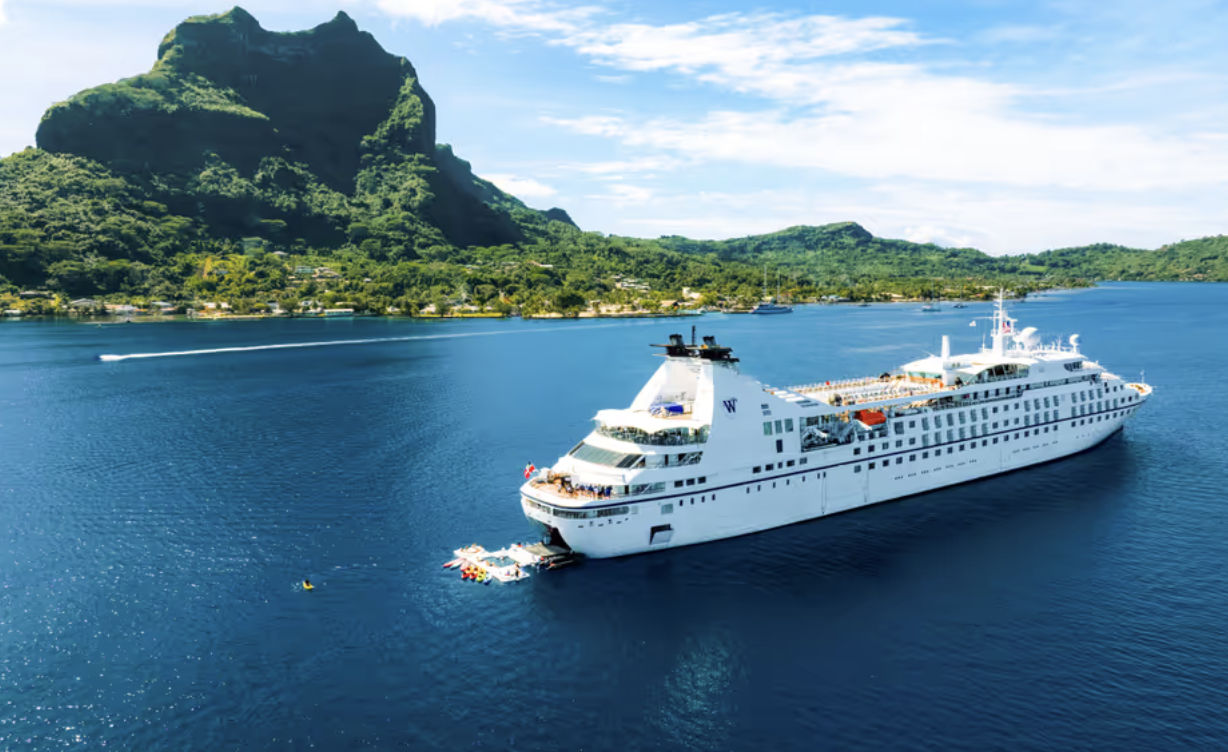
However, “some cruise companies have much smaller ships and offer a more personalized experience,” she says. “For example, themed cruises seek a very different customer base.” Windstar Cruises, which bills itself as “The World’s Best Small Ship Cruise Line,” emphasizes a culinary experience at sea but also on dry land, offering visits to the market with the ship’s chef at some destinations to select ingredients for the evening meal.
Choosing a cruise on which passengers stay for one or more nights in a port also makes more in-depth visits possible. For example, Vachon says, “Azamara Cruises makes longer stops at ports of call.” And it has a small ratio of passengers to crew— 350 to 400 crew members for about 700 passengers.
Expedition Cruises: Luxury and One-of-a-Kind Experiences
Bussières says that one of her best cruising memories is of the time she visited the British Virgin Islands with Regent Seven Seas Cruises. She also had a memorable time in Greenland on a Quark Expeditions ship. Besides the polar plunge, which she still recalls with emotion, she liked the company’s social and environmental commitment. “Its technology allows it, for example, to adjust the noise levels when animals are present,” she says.
Wildlife conservation is also a concern for the French shipowner Ponant Explorations Group. Since 2020, one of its ships, the Jacques-Cartier, has carried the Underwater Radiated Noise notation issued by the safety and verification body Bureau Veritas Marine & Offshore, attesting to the company’s efforts to monitor its ships’ “acoustic signature” and limit noise levels to reduce negative effects on marine life.
By 2030, Ponant Explorations plans to launch the first zero-emissions cruise ship, Swap2Zero, which will use wind and solid oxide fuel cells powered by LNG—liquified natural gas—as well as having carbon-capture technology to cover energy requirements on board.
River Cruises: A Slower Pace
Over the past few years, several major companies in the tourism industry, such as Celebrity Cruises, have added river cruises to their options.
CroisiEurope, based in Strasbourg, France, has specialized in this type of travel since 1976. The European rivers that provide the routes for their voyages include the Rhine, the Seine, the Rhône, the Saône, and the Gironde. Themed cruises, such as those built around hiking, gastronomy, wine, and Christmas markets, are also available.
“This is a kind of slow travel that is calming,” notes Axel Araszkiewicz, in charge of external relations for the company. “While sailing, you can gaze at the landscapes passing by. Smaller vessels with greater mobility allow access to a city’s downtown core.”
Another plus with smaller ships, he says, is that “on a river, swells are very rare, which means no seasickness.” He recommends in particular sailing the canals of France and Belgium. “On the canals of Alsace, Bourgogne, Provence, Champagne, Île-de-France, Oise, and Doubs, the water is even calmer.”
Bussières, too, recommends river cruises—and for a very practical reason: “Some passengers are wary of germs and prefer to stay near cities.”
Whether it’s a cruise on a river or on an ocean, one thing is certain: small boats are popular. Of the 73 that will be built by 2031, half will accommodate fewer than 2,000 passengers. What about prices? While mega cruise ship trips may appear more affordable, Bussières points out that “when you see a promotion for a Caribbean cruise with MSC Cruises at $499, you might think it’s inexpensive, but then you have to add port and government taxes, excursions, beer, wine, et cetera.”
While the prices for expedition cruises might seem high, there will be no such surprises in store.