


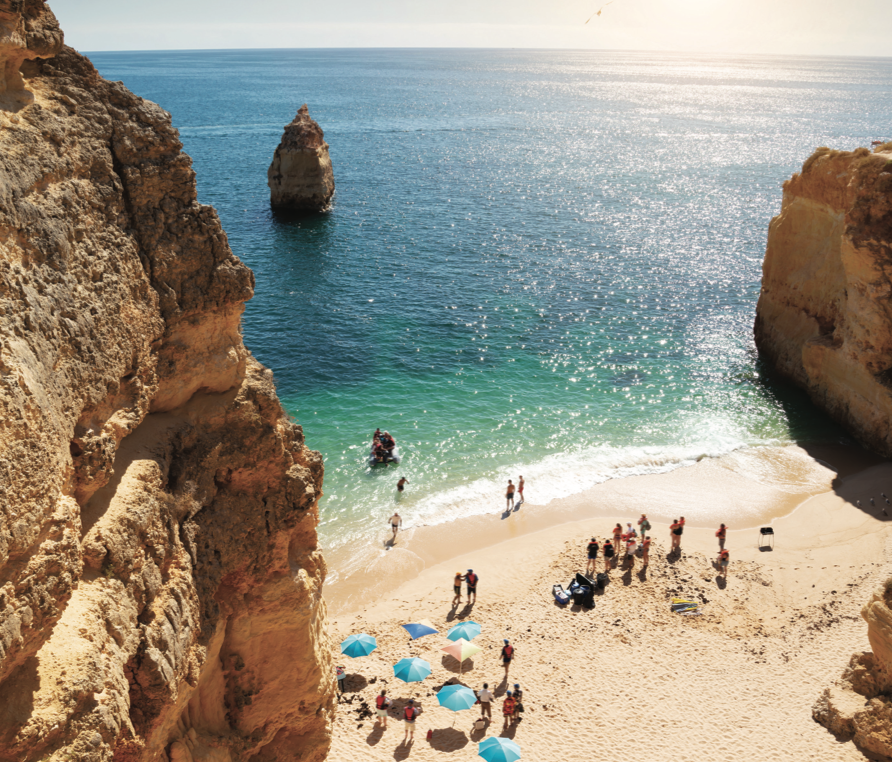
Boasting some of Europe’s most beautiful beaches and bathed in sunshine 300 days a year, the Algarve region on Portugal’s southern coast is a popular destination for snowbirds that brilliantly blends tourism and culture
By Gary Lawrence
Lagos
The capital of the Algarve from 1576 to 1756 and the home port of many ships that set out to explore the world in the 15th and 16th centuries, Lagos is also known for being the location of Europe’s first African slave market, in the 15th century.
Today, a small museum recalls this grim episode in the city’s history, while not far from there, the opulent gilding of Santo Antonio church (1707), which adjoins the municipal museum, reflects the importance of—and the wealth generated by—colonial trade.
Behind the crenellated ramparts that surround Lagos, the historic centre is worth strolling through, with its lively narrow streets dotted with quiet terraces and flanked by facades covered with azulejos (glazed tiles) or modern frescoes. Still intimately tied to the ocean, Lagos now serves as a starting point for excursions on the sea, whether it’s kayaking to the famous Benagil Cave with its natural skylight or watching dolphins frolic offshore.
Sagres and Cape Saint Vincent
Like Lagos, Sagres, nicknamed “the End of the World,” saw many illustrious sailors leave to explore the wider world.
The city’s imposing fortress, which sits atop a cliff, features a fascinating historical site: the Centre of Discoveries. It was there, in 1420, that Prince Henry the Navigator founded his famous school of navigation to plan many major expeditions to the Americas and Asia.
Just east of there, the lighthouse on the dizzying Cape Saint Vincent seems to stand guard; long considered the farthest limit of the world, it is still the most westerly site in continental Europe.
Between Sagres and Cape Saint Vincent, surfers try to catch the waves of the Atlantic, watched by onlookers who await the fabulous sunsets that light up the cliffs with their glowing rays.
Faro
The gateway to the Algarve, this attractive city encircled by thick walls has survived two sackings by crusaders, two earthquakes, and a tsunami in the 18th century. Faro was occupied by the Phoenicians, the Carthaginians, the Romans, and the Moors, and its small historic centre is a delight to roam, from the gracious bishop’s palace to the municipal museum that houses well-preserved Roman mosaics.
Outside the walls, the remarkable Capela dos Ossos (Bone Chapel) of Nossa Senhora do Carmo (Our Lady of Mount Carmel) church features a different type of interior: the skulls and bones of a thousand Carmelite monks are sealed in its walls for eternity to remind mortals of the fragility of their existence.
Quinta do Lago
This tranquil, luxurious, and naturally pretty enclave in the midst of the Algarve celebrates the lighter side of life. Made up of a range of hotels, establishments, and high-end villas clustered in a kind of tourist-accommodation village, Quinta do Lago includes a golf course, a freshwater lake, and appetizing restaurants.
A boardwalk crosses the salt marshes of Ria Formosa Natural Park and leads to an incredible beach the colour of brown sugar that is never crowded, even at the peak of the high season.
Although at times it feels more like Florida than the Algarve, the Quinta do Lago resort complex makes an excellent home base for exploring the coast and spending time as a family, especially at the wonderful Martinhal resort.
Silves
As soon as you see it in the distance, in a valley of orange and olive groves, the walled village of Silves will dazzle you: its crenellated ramparts and four-sided towers wrap around its old city, built at the top of a hill where white or almond-coloured houses follow one after the other and oleander, jacaranda, and mimosa trees perfume the air.
Once the capital of the Algarve, at the time the Moors occupied it, today it’s an irresistible little town located far from the sea and crisscrossed by peaceful narrow streets that follow the route of the old Arab quarter. The area is ideal for lazing around in the shade and sipping a glass of Lagoa or Portimão wine, made from the two varieties of grapes that grow abundantly in the vineyards around Silves.
Alte
Often described as “the most typical rural village in Portugal,” Alte rises from a hillside, 30 minutes from Silves, in the heart of the Caldeirão mountain range. Its streets featuring white-washed houses encircle Nossa Senhora da Assuncão (Our Lady of the Assumption) church and the main square, and some of them lead to fontes (springs) with wells and water mills.
This adorable village is also dotted with flower gardens, and cascades of flowers tumble in a flurry of vibrant colours. After you’ve dined on cataplana (fish stew) on one of the village’s rare terraces, enjoy a glass of aguardente de medronho, a traditional fruit brandy typical of the Algarve.
Tavira
If you look up in this little seaside town, you’ll spot touches that recall the ocean on the facades and roof edges: shells, stylized ship figureheads, and seahorses adorn places such as the church, a multi-storey building, and a carved door.
Although the port of Tavira is sandy today, this quaint town near the Spanish border remains closely linked to the sea. Its Roman bridge still spans the Séqua (or Gilão) River, and its Moorish castle (Castelo dos Mouros, 1292) towers over its heights, as if to recall the presence of its former Arab occupants, who dominated the Algarve from the eighth to the 13th centuries.
Whether you take the castelo’s parapet walk to admire the pyramid-shaped roofs or stroll the lovely boardwalk along the pier planted with palm trees, you’ll end up wanting to take the ferry to Tavira Island, just south of the town, where the beaches stretch as far as the eye can see and ultimately blend into the sea. In this way, you can put yourself in the shoes of mariners of days gone by, who had only the sky and the sea to mark the horizon.
4 Beaches Where You Can Lounge Guilt-Free
1. Praia da Bordeira. Far from the hustle and bustle of the south coast, this massive, ruggedly beautiful beach is found on the Algarve’s western coast, near Carrapateira.
2. Praia da Ilha da Armona. Located off the charming fishing port of Olhão, the sweet island of Armona is bordered by bucolic beaches on the south coast.
3. Praia da Ilha da Barreta. South of Faro, this strip of sand that can be reached by boat is part of Ria Formosa Natural Park and has a desert-island vibe.
4. Praia da Marinha. Just east of the cute fishing village of Carvoeiro, this gorgeous beach with a backdrop of spectacular ochre cliffs features shimmering waters that are ideal for snorkelling.
Good to Know
• The cost of living in the Algarve is lower than that in other European countries, and there are various options for affordable accommodations.
• TAP Air Portugal connects Toronto and Montreal to Lisbon and also serves several regional airports, including Faro. The Algarve can be reached in 3.5 hours by train from Lisbon.
• In the Algarve, the period from May to September is fairly busy— July and August are especially bustling. It’s better to choose another time of year, when the temperatures are cooler but the sun still shines eight to nine hours a day.