


If you’re looking for an accessible activity that’s good for both your body and your mind, sitting yoga might be right up your alley
By Jacqueline Simoneau
Being inactive leads to stiff joints, tight muscles, and limited physical endurance. If high-energy physical activity isn’t for you, a gentler but nevertheless effective workout like chair yoga might be just the thing. This adapted version of traditional yoga consists of doing poses safely and comfortably.
“Although chair yoga is perfect for seniors and people with mobility problems, balance issues, or chronic pain, everyone can benefit from it, whatever their age or physical condition,” promises Carole Morency, a yogi and author. One of the advantages of chair yoga is that you can do it anytime, anywhere, at your own pace and taking into account your abilities and limitations. The activity is especially helpful for workers who spend many hours seated, to help them release built-up tensions without leaving their office, and each session takes only a few minutes.
Gentle But Not Easy
This form of exercise might seem too passive, but nothing could be further from the truth. It’s a lot more active than you’d expect.
“Chair yoga fits in well with a physical training or fitness program,” says Dr. Louis Bherer, neuropsychologist, researcher, and director of the Centre Épic de l’Institut de cardiologie de Montréal (EPIC Centre of the Montreal Heart Institute). “It helps to strengthen muscles. Even when seated, you can work the deep back and torso muscles. Also, yoga involves physical and mental exercises.”
Like traditional yoga, the chair version helps improve strength, mobility, and balance to reduce the risk for falls. Stretching develops flexibility and reduces muscle and joint tension. The deep-breathing techniques and meditation calm stress, promote relaxation, stimulate concentration, and help you develop greater self-awareness.
According to Morency, this type of yoga encourages good posture habits throughout the day but also during yoga. “Many people who do poses on a mat aren’t positioned properly and so risk injury,” she says. “By offering a solid foundation, the chair facilitates body alignment and stretching.”
In addition to being a recognized physical and anti-stress activity, chair yoga—like other forms of exercise— has a positive effect on overall health. “Scientific research studies clearly show the benefits of exercise on the brain,” Bherer says. “Doing a physical activity regularly improves memory and reduces the risk for age-related cognitive decline. Also, studies have shown that doing yoga promotes better cardiovascular and respiratory health. It’s also of interest in treating health issues such as chronic-pain management and musculoskeletal disorders. And in acting on stress and anxiety, it mitigates the risk for depression.”
Finally, many research studies have shown that yoga has benefits for people living with diseases such as Parkinson’s, multiple sclerosis, and arthritis, Morency says. Chair yoga is therefore an excellent ally for those who want to maintain their quality of life for as long as possible.
Ready, Sit, Move!
Many yoga studios offer classes so that you can get to know the movements and poses adapted to your physical condition and learn to do them properly. But you can do chair yoga at home, using a book on the topic or taking an online class given by a qualified instructor.
Very little equipment is required, aside from a stable, solid chair without armrests that allows you to have your feet flat on the floor. Other accessories can include a non-slip mat to put under the chair to stop it from moving during the exercises; a cushion to help you maintain a proper, comfortable pose; a stretching strap that allows you to work a limb while avoiding unnecessary strain; and a yoga block made of cork or wood to provide you with support for certain poses. Your clothing should be comfortable and allow you to move and stretch freely. Chair yoga is done in bare feet or non-slip socks.
“A typical session starts with a brief warmup, including conscious breathing and stretching exercises,” Morency explains. “Then we do adapted poses, and we end with a period of relaxation.”
Sessions don’t have to be long for you to feel the benefits, as long as you do the activity regularly. It’s better to do 10 minutes often than an hour occasionally, Morency says. Ideally, start with one or two 15-minute blocks each week, and gradually increase the duration. You can also do short five- to 10-minute sessions several times a day, as the need arises.
Two Easy Exercises
Yogi Carole Morency suggests these two simple poses for those who want to give chair yoga a try.
Seated Twist
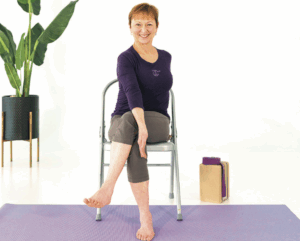
In a seated position, gently turn the torso to the right, placing your right hand behind your back and the other on the left thigh. Inhale deeply, lengthening the spine. Exhale. Hold the pose for five breaths. Repeat on the other side. This pose stimulates, among other things, digestion and the immune system and relieves back tension.
Extended Side Angle
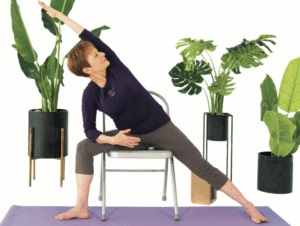
Sitting on the edge of the chair with your legs apart, stretch your right arm above your ear, gently bending the opposite side of the body. Press your left arm against your thigh to support the pose. Hold for five deep breaths. Repeat on the other side. This movement works lateral flexibility, torso tone, shoulder mobility, and deep breathing. It also promotes relaxation.