


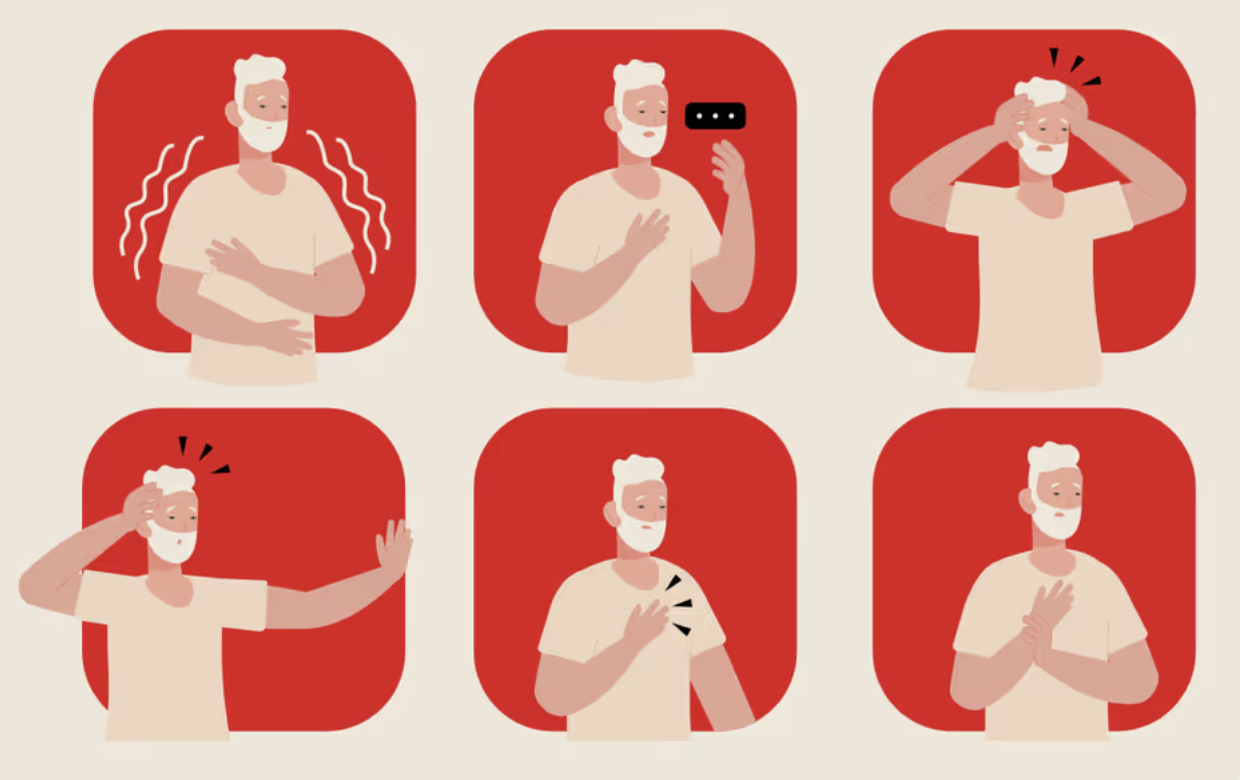
Knowing your risk factors and reacting quickly to the signs of a stroke can save your life
By Florence Dujoux
A stroke is a medical emergency that occurs when part of the brain is deprived of blood. There are two major types: ischemic, also called a brain infarct, in which a clot blocks a blood vessel in the head (more than 80% of cases), and hemorrhagic, which happens when a blood vessel bursts in the brain (fewer than 20% of cases).
Clear Signs
The Heart and Stroke Foundation of Canada sums up the most common symptoms with the mnemonic acronym FAST:
F for Face: Is it drooping?
A for Arms: Can you raise both?
S for Speech: Is it slurred or jumbled?
T for Time: Call 9-1-1 immediately.
Sometimes stroke symptoms appear and then disappear on their own, often within the hour. “These are warning signs of ischemic stroke,” notes Dr. Christian Stapf, a vascular neurologist at Montreal’s CHUM hospital.
“A blockage is forming in the vessels, which results in small clots with a temporary effect before a large clot completely blocks the artery.” If you have such a transient ischemic attack (TIA), or “mini-stroke,” you should go to the Emergency Department to be checked.
“You have to recognize the signs of stroke and call 9-1-1 right away because in the first few hours, we can easily treat the symptoms and sometimes even make them disappear,” says Dr. Stapf.
“Enemy Number One is the time between the onset of the stroke and when we can treat it,” warns Stapf, who is also a professor in the Department of Neurosciences at the Université de Montréal. In most cases, the patient feels no pain. “Pain isn’t a common symptom of a stroke,” says Guillaume Lacombe, an emergency-room physician at the Centre hospitalier de Lanaudière and vice-president of the Association des spécialistes en médecine d’urgence du Québec (Quebec Association of Emergency Medicine Specialists).
After arriving at the Emergency Department, a patient will be given a brain scan to determine the type of stroke. For an ischemic stro ke, doctors have a window of 4.5 hours following the onset of symptoms to administer thrombolysis, a procedure using medications to dissolve the clot. This allows for partial or complete recovery in at least one-third of cases.
Those with a more serious stroke, when a large artery in the brain is clogged, can undergo a surgical intervention—a thrombectomy—to remove the clot. The stroke disappears in around half of these patients if the surgery takes place within 12 to 24 hours. Treatment for hemorrhagic stroke can include controlling blood pressure, medication to reverse the effect of blood thinners, and sometimes cranial surgery.
Long-Term Effects
Stroke patients stay in the hospital for a few days for treatment and so that doctors can determine the cause of the stroke and make sure there are no complications, says Josiane Arsenault, a nurse counsellor in specialized care at the CHUM’s Emergency Department. In addition, a multidisciplinary team with expertise in areas such as physiotherapy, occupational therapy, and speech therapy will develop a rehabilitation plan. Some patients are then transferred to a rehabilitation centre.
The long-term effects vary from person to person. Their severity depends on how long it took to get treatment, the location and scope of the stroke, and the patient’s health history. Effects can range from loss of dexterity to paralysis and may include problems related to memory, speech, and walking.
Your Risk
Some factors you can’t do anything about. First, 80% of all strokes occur in people over age 60. Women are disproportionately affected: 23% more women than men died of a stroke in Canada in 2023. Few women are aware of their increased vulnerability—during menopause, for example, due to a drop in estrogen levels.
However, you can control a number of vascular risk factors. “The main killers are cigarettes, high blood pressure, and diabetes,” Stapf says. Controlling these is all the more important because they affect all the arteries and increase the likelihood of both stroke and cardiac events.
Family history should also be taken into consideration. At heartandstroke.ca, the free Risk Screen tool can give you an idea of your risks. Completing the questionnaire about your lifestyle, family history, and health problems takes less than 10 minutes. You’ll get a customized report summing up the risks you can change, those you can’t change, and those that are under control, with recommendations for reducing your risk.
Common and Serious
In Canada, someone has a stroke every five minutes. Strokes are:
• the leading cause of disability;
• the second-highest cause of loss of intellectual ability;
• the third-highest cause of death.