


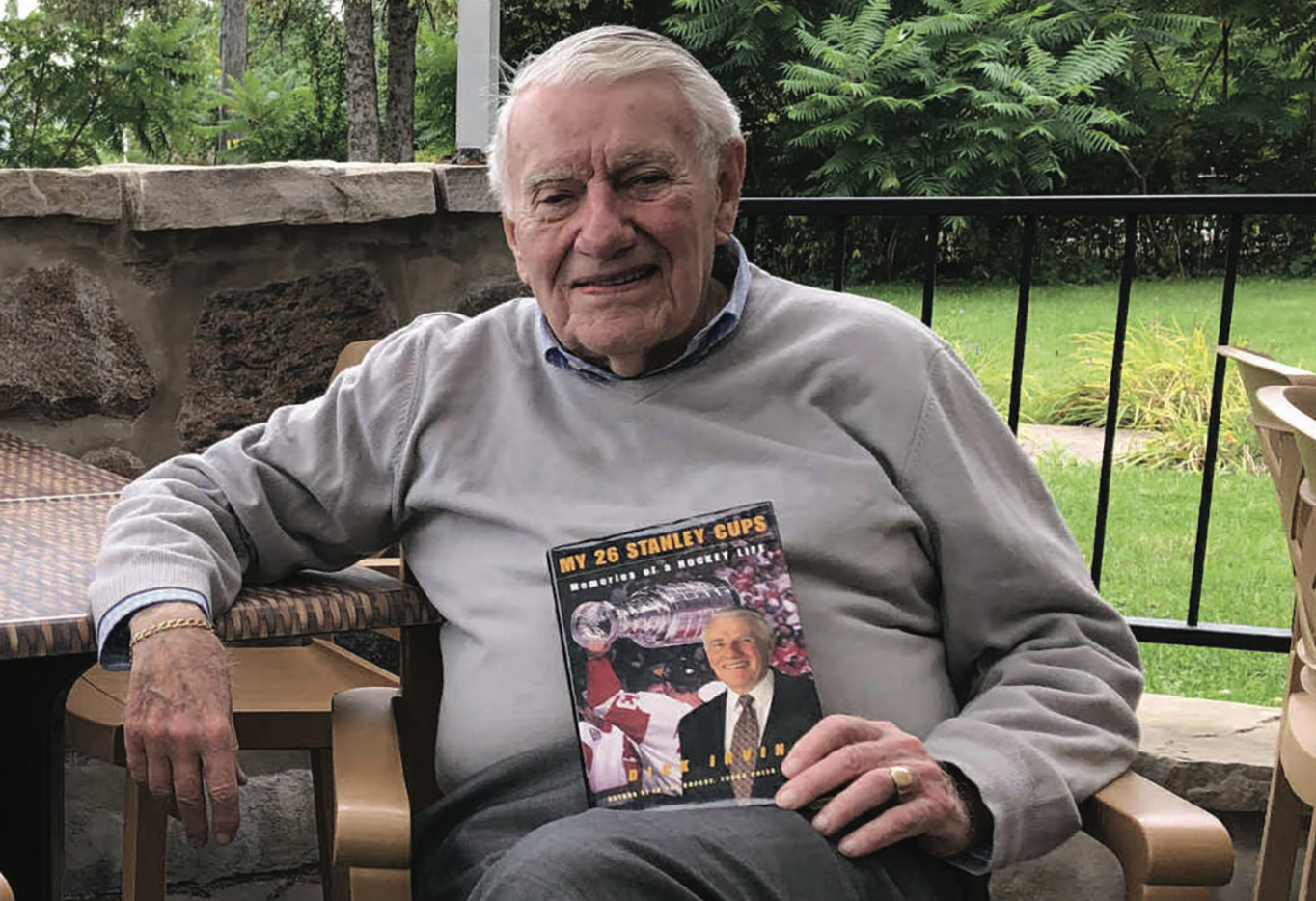
Broadcaster and author Dick Irvin reflects on his early life and his years as one of Canada’s best-known sports commentators
By Rob Lutes
Where were you born, and where did you grow up?
I was born in Calgary. When you’re a broadcaster, you never grow up. [Laughs.] No, I grew up in Regina. My dad built a house there for his parents in 1923, when he went there to play pro hockey.
You’ve spoken about your father, also Dick Irvin, as having been a major influence in your life. He had a great career as a hockey player and a hall-of-fame coach in the NHL. Was he from the West?
My dad grew up in Winnipeg. He served in the First World War with the Fort Garry Horse regiment. He was a motorcycle dispatch rider at the front. He suffered a head injury, and when the war ended, he was in a military hospital in France. When he got back to Canada, he picked up his hockey career. You’ve probably heard of the award that goes to the top American college player, the Hobey Baker Award? Hobey Baker was a great hockey star in the United States. I have a clipping from a news story of that era that asked “Who was the world’s greatest amateur hockey player? Hobey Baker or Dick Irvin?”
While he played in the NHL, your father is better remembered for his coaching career with the Chicago Blackhawks, the Toronto Maple Leafs, and then the Montreal Canadiens for 15 seasons. Your family remained in Regina for much of his coaching career.
Yes. The first four years of my life, we moved to Toronto in the winter when he was coaching, but when I started kindergarten, my parents decided that they wouldn’t move. My dad had a lot of business interests in Regina. He was in the chicken business, mainly as a hobby, and he was in the dog business as a breeder. And his father lived with us until I was 12 years old. So he had a lot of very strong ties to the West.
Did you play sports as a young person?
Yeah. Just not very well. I played college hockey at the University of Saskatchewan for two seasons, and then when we moved to Montreal in 1951, I played two seasons for the McGill Redmen. But the sport that I got to be the best at was golf. I played golf regularly until I was 87 years old. Started when I was 13, on sand greens in Regina.
How did you get into broadcasting?
I worked eight years in business in Montreal, mainly for the Shell Oil Company. And then CTV came on the air— CFCF-TV in Montreal—on January 20, 1961, and I remember rushing home from work to see the new station come on the air at 6 p.m. on that Friday night. Brian McFarlane was the sports director, and he was swamped with work. He was from Toronto and didn’t know the market too well.
I met him at a Canadiens game right around then—I was the official scorer at the games at the time—and we got talking. Minor Hockey Week was coming up and I was coaching minor hockey. In fact, the team I was coaching, the bantam team in the Town of Mount Royal, won the provincial championship. I can tell you this: I had a wonderful career broadcasting hockey, the Olympic Games, and whatever, but the biggest thrill I ever had in sports was when I coached those kids to the provincial championship in 1961. Anyway, because of Minor Hockey Week and because my dad had been who he had been, Brian said, “Would you like to come up and be on the show?”
So I went up on a Sunday afternoon, and we did it live. I guess they couldn’t shut me up, and now I had the bug. Later, Brian was looking for an assistant, so I took the audition and they hired me. May 8, 1961, was my first day in broadcasting. I made $75 a week. All my buddies from school thought “Oh, wow, he’s on television at night doing the news. He must be rich.” And that’s how I got started.
Many Canadians know you from hockey broadcasts, on the radio in Montreal and nationally on CBC starting in the 1960s. For 17 years, you were part of a legendary broadcast team alongside Danny Gallivan. What was it like to work with him?
It was very natural. Easy. It just fit. When I started, I’d known Danny for many years through my father. Danny hated meetings, so we never ever talked about how to broadcast the hockey game. But what did I learn from Danny Gallivan? I learned preparation. He used to have lots of notes written on the cardboard that came with your shirts from the dry cleaner. We used to call it “Danny’s shirt board.” People often ask me for my all-time career highlights. I have two. One was being the English emcee for the official ceremony the night they closed the Montreal Forum. And the second highlight would be my 17 years with Danny Gallivan.
In your broadcasting work, you seemed to bring some history and perspective to every game you covered. Did you have a mentor in broadcasting who inspired that?
No, I don’t think so. But hockey history was always part of my life, and I just continued to make it part of my life. The one thing that a lot of people seem to remember from my broadcasts is that when I was doing the games on radio, I would say “the Canadiens are skating from left to right on your radio dial.” I still meet people who remember that.
Apart from hockey, you have covered many other sports over your career.
Oh, yes. I did the Alouettes for eight years starting in 1965 with Tex Coulter, a great lineman for the New York Giants and the US Army teams who had played for the Alouettes. I also did golf on CTV for 20 years, and I really enjoyed that. People used to ask me after I retired, “Do you miss the hockey?” And I used to say no—I did miss the people, but I didn’t miss the games—but I actually missed the golf. I guess it was because I played it myself. I was down to a four handicap at one time and competed for my club, and I played in some pro-ams with pros, whereas I never skated beside Jean Béliveau in hockey.
You also worked on some Olympics broadcasts. How was that experience?
That was great. I did the opening ceremonies in Lake Placid—the Miracle on Ice year [1980]—and I did a nightly wrap-up show on CTV during the Montreal games. I was at the Innsbruck games [1976] with CTV. I was one of two broadcasters who didn’t have a day off for the 19 days of the games that year. And I had all kinds of sports that I knew absolutely nothing about—biathlon, luge, bobsledding, cross-country skiing. But it was a great experience. And it was so well run. I never saw anything like it in my life.
Along with broadcasting, you had great success as an author, with six bestselling books over your career. Were you asked to do that or did you want to?
I started all that. I had done some writing. I wrote all my own stuff at CFCF—every newscast. How many thousands of those did I do in 30 years at CTV? So I wrote the first book, Back to You, Dick, about my life. The first 100 pages were about my dad’s career and the rest about my experiences. And I wasn’t really going to write another one. Then
I read a book called Bums, a history of the Brooklyn Dodgers done by interviewing all the players, the old guys sort of reminiscing. And I said, “I can write a book like this about the Canadiens.” I did that one, and then I did the same kind of oral-history book for goalies, and then coaches, and then referees. That was fun, to meet all those guys. The last book was a real book, my own words, about my Stanley Cup memories.
Speaking to you today, you seem as if you could step into the booth and call a Canadiens game tonight, yet you’re 93. How have you approached aging?
Well, you know, I worked quite a bit. The last game I did was Detroit in Colorado in 1999. I hosted the NHL awards show after that season was over. And two or three days after that, I called the boss at CBC, John Shannon, and I said, “John, I’m retiring.” And he said, without even stopping to take a breath, “No, you’re not.” He told me I could leave the booth but that he needed me to do some of the tradition and the history. So he kept me on the payroll, and I did things like Hockey Day in Canada and old-timers games. It certainly wasn’t a regular thing, but they called me every year for 10 years. So I kept my hand in. I kept busy.
You were in the booth for 21 Stanley Cup winning games and 19 NHL all-star games and saw thousands of others over your career. Are there special moments in your broadcasting career that stand above the rest?
With the Canadiens, it was probably Scotty Bowman’s second Cup, when they beat Philadelphia in four straight games. The Flyers had won the Cup the previous two years, ’74 and ’75. The last game in Philadelphia was quite something. And I think the last one the Canadiens won in 1993. Also, the first Flyers Cup in 1974, when they beat Boston 1–0 on a Sunday afternoon at the Spectrum in Philadelphia to win the Cup. That was an amazing moment for me. A very historic moment because it was the first time the new beat the old. And I would also add the two Cups that Mario Lemieux won with Pittsburgh in 1991 and 1992. I never saw anybody play the game the way he played those two years.
Speaking to you today, you seem as if you could step into the booth and call a Canadiens game tonight, yet you’re 93. How have you approached aging?
Well, you know, I worked quite a bit. The last game I did was Detroit in Colorado in 1999. I hosted the NHL awards show after that season was over. And two or three days after that, I called the boss at CBC, John Shannon, and I said, “John, I’m retiring.” And he said, without even stopping to take a breath, “No, you’re not.” He told me I could leave the booth but that he needed me to do some of the tradition and the history. So he kept me on the payroll, and I did things like Hockey Day in Canada and old-timers games. It certainly wasn’t a regular thing, but they called me every year for 10 years. So I kept my hand in. I kept busy.
I was even on the CBC Hockey Night in Canada broadcast on December 1, 2024, to mark the 100th anniversary of the Bruins playing the Canadiens. I first appeared on the show, I think, in 1966. So you figure out the gap between those dates, and it’s almost 60 years. So I didn’t just stop working and wake up the next morning and say “Now what do I do today?” I’ve always had these things in my future.