


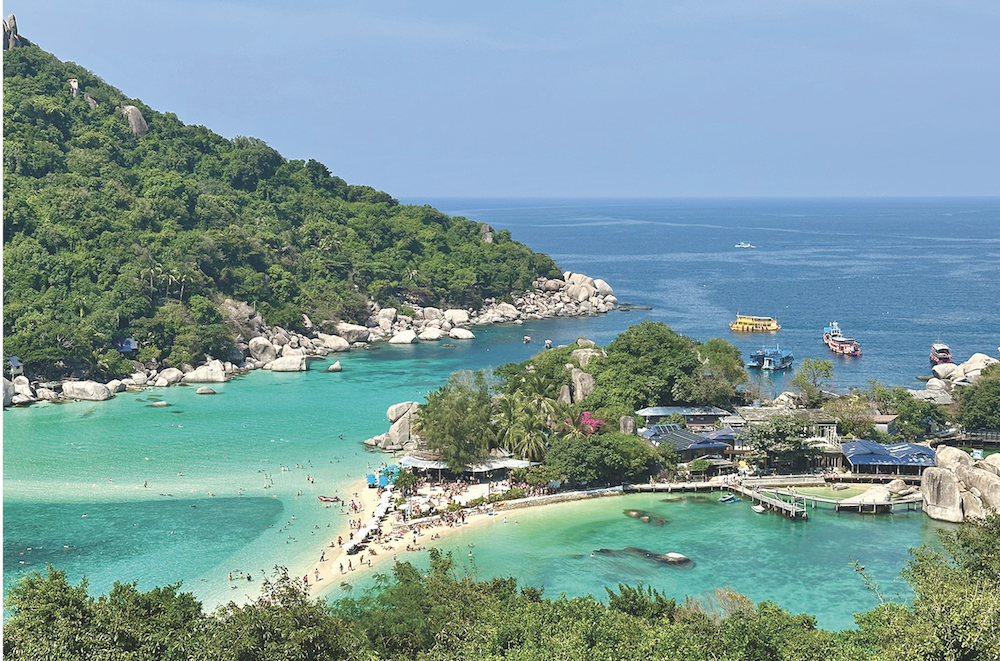
Given the current political climate, many people are thinking twice about wintering in Florida. Our correspondent decided instead to make a dream come true and headed to Thailand and its friendly southern neighbour Malaysia.
By Carolyne Parent
I’ve been travelling to Asia for 25 years—from Türkiye to South Korea, from Bhutan to Indonesia. For a long stay, I cannot recommend Thailand and Malaysia highly enough. They’re a perfect pair. Yes, I know. It’s far. I can even hear a few people thinking “Far and possibly dangerous.”
In all honesty, I think that these days, you’re more likely to run into trouble in Washington, D.C., than on the beaches of Thailand’s Koh Lanta district.
Meanwhile, Malaysia is in second place on the Global Peace Index’s list of the safest countries in Southeast Asia. I spent 10 weeks on my own in these two countries last winter, and I don’t have a single mishap to report.
Thailand brings together everything I love: smiling people, a rich culture, fragrant cuisine, incredible seabeds (I went scuba diving), and well-developed bus and train systems that make it easy to get around. In the north, Chiang Mai is a small and adorable walled city with a great tradition of craftsmanship. (It was the cultural centre of the former Kingdom of Lanna.)
It’s also an excellent base camp for planning your visit to an elephant sanctuary—and, yes, there are ethical ones. Perhaps you’re dreaming instead of the heavenly views of the islands of Koh Phi Phi in the Andaman Sea off the west coast—or, if you’re a fan of the TV series The White Lotus, the island of Koh Samui off the east coast in the Gulf of Thailand.
On Koh Samui, you can even spend a few nights by the sea at Anantara Bophut Koh Samui Resort, an elegant hotel featuring traditional workmanship, where several scenes in the third sea- son were filmed.
Phang Nga: Beating the Tourist Horde
However, it was the Khao Lak coast, north of the overly visited island of Phuket on the west coast, in the province of Phang-Nga, that I loved the most. I valued the ease of living by the Andaman Sea and the various excursions that offer views of spectacular landscapes both below and above the waves. In the Similan islands, you can play Robinson Crusoe and do the best free dives of your life. Access to these waters is prohibited five months a year to protect the marine life.
Ao Phang Nga National Park marine park is known for the island of Ko Khao Phing Kan and its incredible peaks. You may have seen them: it’s also known as James Bond Island because the movie The Man With the Golden Gun was filmed there.
A practically deserted beach like Bang Sak is rare these days. Along its six kilometres (3.75 miles) of powdery sand are just a handful of hotels. One of them, Avani+ Khao Lak Resort, is a family establishment. Even if you don’t stay there, I suggest you eat there under the stars: The Beach House restaurant serves tasty traditional dishes including fruits, vegetables, and spices such as betel leaf that are grown on-site. The fish come from the sparkling sea nearby.
Finally, here’s some friendly advice for Thailand: don’t spend too much time in Bangkok, which will never, ever win a beauty contest. Three or four days is plenty to recover from getting there, acclimate to the heat, and visit the Grand Palace and Wat Pho to admire its Reclining Buddha.
And because this temple is where Thai massage was born, be sure to get one while you’re there. You’ll be in very good hands!
Malaysia: Food and Culture
I must confess that I prefer Malaysia to Thailand. First, because there are fewer Westerners there. Second, because it’s a complete change of scene, especially in insular Malaysia, that is, the states of Sabah and Sarawak, on the island of Borneo, a name that is enough to transport you back to the pages of an old issue of National Geographic. For me, it recalls the jungle and the red orangutans (“men of the forest” in Malay), as well as the longhouses of the proud Iban warriors of days gone by. And third, the cost of living there is, at a rough guess, a good 15 per cent lower than that in its northern neighbour, which doesn’t hurt.
On my last visit, my first stop was George Town, on Penang Island. The city, which is the heart of the country’s street-food scene, had been calling to me for a long time. Declared a UNESCO World Heritage Site for its superb collection of colonial buildings, shops, and Chinese clan houses, the city is also known for its Peranakan villas— the Peranakan culture grew out of the marriages of the first Chinese immigrants to Malaysian women.
The recent addition of the Malaysian breakfast culture to UNESCO’s list of the Intangible Cultural Heritage of Humanity finally convinced me to go. I really enjoyed it, and not just the roti canai.
In fact, the built heritage of the city’s historic centre and its street art—many frescoes, murals, and wroughtiron caricatures—made me feel as if I were taking part in a kind of artistic treasure hunt. It was fabulous. Another treasure is the nyonya (or Peranakan) menu at Auntie Gaik Lean’s Old School Eatery. Be sure to try the otak-otak, a divine mackerel mousse; the nasi ulam, cold rice flavoured with a dozen herbs; and the caramelized chicken rendang.
With its main dishes priced at under $20, this Michelin-starred restaurant is definitely one of the most affordable of that elite group in the world.
Going Green…and Turquoise
After this cultural immersion, the next stop is the island of Langkawi for the beauty of its granite formations, which are more than 500 million years old. The entire island—the main feature in an archipelago off the west coast in the Strait of Malacca—has been recognized by UNESCO as a global geopark. At Machinchang, several breathtaking features, such as the Sky Bridge, will dazzle you.
The island cruise departing from the Fisherman’s Village pier at Kuah is also very pleasant. But the visit to Kilim Geoforest Park, which includes sailing from the mangroves to the sea to view various ecosystems, was the highlight for me: that’s where I saw langurs, also known as leaf monkeys.
The island’s most popular seaside destination, Pantai Cenang, is the place to be for most visitors, so it’s a bustling spot. I suggest finding a place to stay away from the main road, in a small hotel like Bon Ton, run by an Australian expat who has lived there for 38 years. The site has a lot of cachet, as it includes eight traditional wood houses with pastures populated by water buffalo as a backdrop.
On the north coast, Tanjung Rhu is another option for those seeking peace by the sea. The beach there is even more idyllic. Funny…reminiscing about my trip has made me realize that I want to go back to Malaysia. See you there next winter?
Logistics
- Good months to go: November through March
- Plane ticket: On the Hopper app, you can monitor flights to Bangkok or Kuala Lumpur, with notifications up to six months before departure, to get the best rate.
- Travel health insurance: Some credit cards include excellent coverage for varying lengths of stays based on your age: 60 days for up to age 59, and 31 days for ages 60 to 64. Just purchase additional insurance for a longer stay.
- Length of authorized stays: In Thailand, it’s 60 days. If you want to stay longer? The simplest way is to leave the country and come back: that way, you can get a new tourist visa for another 60 days. In Malaysia, it’s 90 days.