


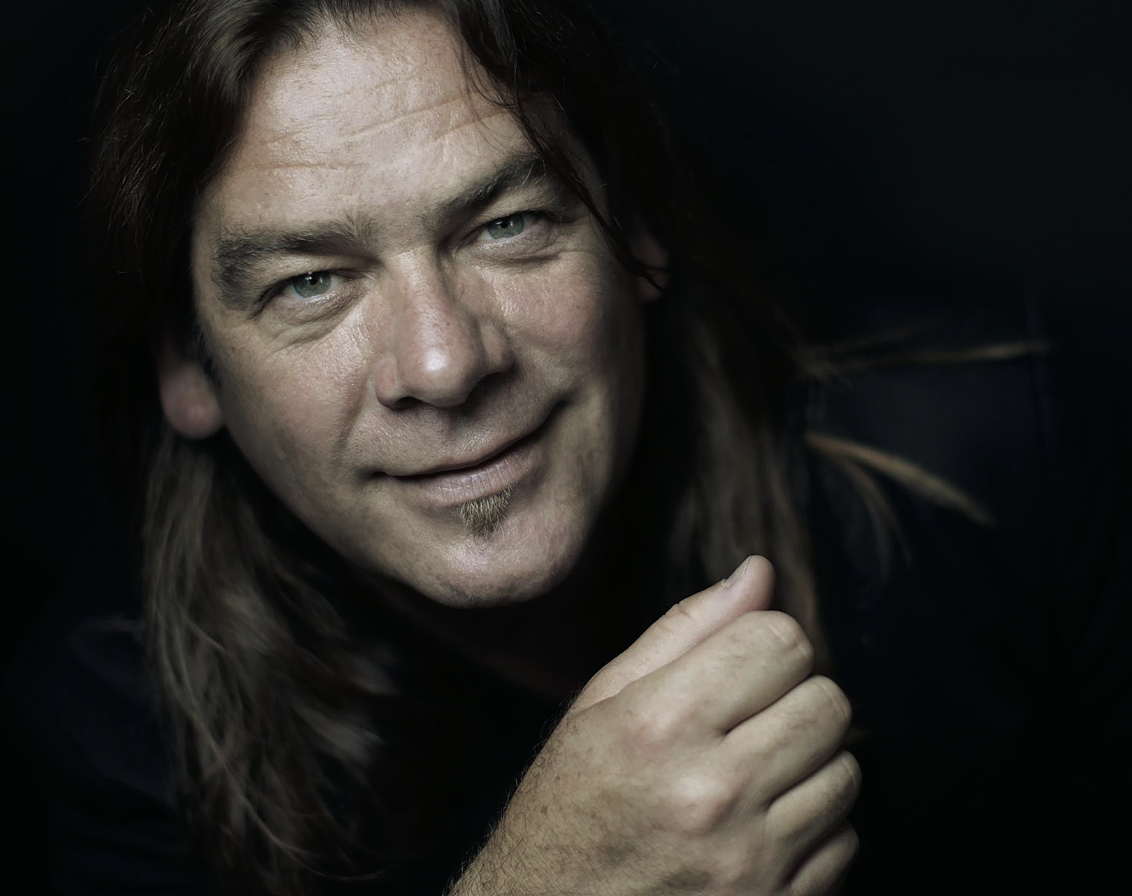
Even after all these years, the man from Petty Harbour still loves touring with his band—and coming home again
By Peter Feniak
“I’m lucky, and I know it,” says Alan Doyle. Well, he may be lucky, but the man has talents and his legend just seems to keep growing. There are his high-energy concerts across North America (and beyond) with his Big Beautiful Band. There’s the praise he won for his onstage turn in the hit musical comedy Tell Tale Harbour, for which he also co-wrote the music and script.
He has also had roles on TV and films and written four warm-hearted bestselling books. The esteemed Newfoundland novelist Michael Crummey has called him “exuberant, irreverent, hilariously funny, and a heart-on-the-sleeve Newfoundlander.”
Doyle’s luck began in the outport town of Petty Harbour, south of St. John’s. He was born into a loving and giving family. In his latest book, The Smiling Land (Doubleday Canada, 2025), he writes: “It came as a great surprise to me in my mid-twenties to learn that I was poor when I was a kid. I honestly had no idea. We had no car or cable TV. We never went on holidays, we really didn’t have modern plumbing and a shower till I was almost a teen. But I was well-fed and warm and safe and loved. And we had a piano and a guitar and an accordion…My folks [had] their priorities exactly right.”
Speaking from his home in St. John’s, Doyle says: “Most kids in Petty Harbour in the early 1980s—I was 11, 12, 13—worked on the wharf in the summer—and happily, too. All the boys would be cutting out cod tongues and throwing cod-liver guts at each other. It was awesome! Of course, by the time you’re 15 or 16, you have jobs where you’re luggin’ or cleanin’ up. And then I got a chance—the luckiest break of my life. It was a teacher at my high school. I’d just turned 16, and she said: ‘They’re looking for summer students in St. John’s. You’re a talkative kid. You should go to apply as one of those summer student tour guides at the Newfoundland Museum.’ I went to St. John’s and I did a job interview—something I’d never heard of. And I got the job. I started working in June of 1985, and I worked there until Great Big Sea started in 2013.”
Great Big Sea, the folk-rock group that energized traditional Newfoundland music and more, would become a great big deal and another important part of Doyle’s story. But it was as a cheerful tour guide that he became fascinated by the rich history of his home province, a place he loves: “I can’t tell you how many times I led people around the Viking display of L’Anse aux Meadows [the earliest known European settlement in North America] and talked about it. I’d never been there. The same with Red Bay, Labrador, and the same with Port au Choix—one of the most significant archaeological finds in North America is in Port au Choix [known as ‘a crossroads of 6,000 years of human history’]. I’d just never been there.”
Work as a museum guide also supported his schooling. Doyle moved to St. John’s and graduated with a Bachelor of Arts from Memorial University. Was his musical style— strong voice, rhythmic guitar—with him then? Doyle laughs. “Well, that’s just part of being a Doyle from Petty Harbour. We’re always at that.”
The musical Doyles, including Alan’s father and uncles, were seen (“late ’60s, early ’70s”) in the CBC-TV music show All Around the Circle. “Then,” Doyle says, “my uncles started playing rock ’n’ roll for dances and clubs. That’s the band I wanted to get into. Three or four uncles of mine were in the band. I would learn all the parts of all the songs and all the instruments, and whichever uncle didn’t want to go and do the Sunday matinee, I’d fill in for him.”
Doyle joined the vibrant live-music scene on George Street in St. John’s. He was a strong performer with a great Atlantic repertoire. And then talent met opportunity. Rankin Street, a top local band, asked Doyle to join. (He claims it was because he had a van.) The new band—Doyle, Sean McCann, Bob Hallett, and Darryl Power—took as its name the local term for a tidal wave: Great Big Sea.
Big Sea and Beyond
As the band’s popularity grew, they began to look outward. “In 1994, when I left Newfoundland for the first time with Great Big Sea, I was very happy to do the gig and sleep on whatever bed we could afford that night,” Doyle says. “And at the time, we couldn’t afford much of a bed.” Great Big Sea rocked the crowded pubs of Atlantic Canada with their high-energy Celtic/folk-rock songs.
After the show, they’d crowd into small rooms, “sleepin’ hard.” They would perform up to 300 days a year. As their reputation grew, paydays and accommodations improved.
The final tour for Great Big Sea began on March 4, 2013, in Los Angeles. Their tours had crossed Canada and the United States and taken the band to Europe and back again. But after the tour-ending show on New Year’s Eve in Moncton, there was news. Popular Sean McCann (“The Shantyman”) was leaving the group. (McCann later revealed that he had to prioritize dealing with the demons of alcoholism.) After some deliberation, Great Big Sea was done.
Doyle carried on. He had long been trying different things. In 2010, he had taken the role of Allan A’Dayle in a new big-screen Robin Hood with his Oscar-winning friend Russell Crowe. He played shady Wolf Redmond on several episodes of CBC-TV’s Republic of Doyle. Years before, he’d been a briefly seen uncredited extra in a film version of Farley Mowat’s A Whale for the Killing, which was shot in Petty Harbour. Doyle was listed in the credits as “boy on a bridge.” Boy on a Bridge became the title of Doyle’s first solo album. Next, publishers who’d been engaged by his down-to-earth storytelling encouraged him to write about his colourful early days. Where I Belong (Doubleday Canada, 2014) became a nationwide success.
And then, with touring still in his blood, he gathered some fine musicians and set out on the road as Alan Doyle and the Beautiful Gypsies. Audiences were waiting. Doyle’s second book delivered stories of people and places he encountered during his touring life. He titled it aptly A Newfoundlander in Canada: Always Going Somewhere, Always Coming Home. When COVID 19 and travel bans struck, the touring stopped. Doyle offered more stories in All Together Now: A Newfoundlander’s Light Tales for Heavy Times. His fans called that bestseller “a great read.” But for Doyle, “noted writer” doesn’t seem a comfortable fit: he identifies himself to his 70,000-plus Instagram followers as “Musician, Actor, Winker, Nodder, Habs fan…and now Author, too, I suppose.”
Did he have to be convinced to attempt a fourth book? “Oh, God, yes,” Doyle responds. “I don’t like writin’ books. I don’t think anybody likes writin’ books. It’s like goin’ to the gym—it’s good to have done. You know it’s good for you and you know you should do it, but you don’t enjoy it. You enjoy walking away when it’s done.” He adds: “I’m always surprised. I think it’s my bestselling book so far. I’m always grateful for that.”
All Around the Circle
Luckily, there was further inspiration to take on the “travels in the home province” project that became The Smiling Land. In conversation, he and his wife, Joanne Pardy—a trained naval architect, a federal employee, and ultimately a home-schooler to their son, Henry—realized that their son, at 18, was no longer a lad: “We were running out of time for him to get in the van with us, let alone get in the van and drive with us to Battle Harbour,” on the southeastern coast of Labrador and 600 kilometres from St. John’s.
With Joanne at the wheel, Alan pecking on a tablet, and Henry adding commentary, The Smiling Land began. The journeys went “all around the circle” (as the Newfoundland folk song has it) of the massive province, visiting historic, fascinating, often reinvigorated communities. The narrative of three opinionated travellers in a van added spark to the writing, as did Doyle’s conversations with people in communities he’d long hoped to see.
Today, Doyle stands amazed at the change that has happened in attitudes towards his province. He puts it plainly: “We’ve gone from being the Newfie joke book to this revered place, the coolest place in the country with the hardest-working, funniest people.”
What happened? First, Canadians were deeply moved when Gander welcomed those who landed there during the 9/11 crisis. Then there was the mighty musical, Come From Away, that grew from the event. Canadians also loved the captivating tourism commercials showing the province’s beauty on sunny summer days. Who wasn’t drawn to a perfectly restored Viking settlement? Or a stroll among the multicoloured jelly-bean houses of St. John’s?
Doyle adds, “The talent made a difference, too.” Fine actors, writers, artists, comics, and musicians continue to emerge from these shores. “It’s unbelievable to me,” he says, “how much it has swung in one person’s lifetime.”
Of course, challenges remain. The 1992 cod moratorium rocked the fishing industry. Outports fell silent. Some communities have been reborn after that blow; some have not. Doyle’s title, The Smiling Land, comes from “Ode to Newfoundland,” the provincial anthem written by Governor Sir Cavendish Boyle in 1902. It describes life in summertime. Doyle notes that not every day mimics those beautiful tourism ads. The weather can be tough; so can isolation.
But, he says, “I think that Newfoundlanders are used to tough times.” And that, many say, builds character.
Has success changed this proud Newfoundlander/Labradorian? “I feel like that’s for someone else to answer,” he says. “I feel like the same guy. I still want to do what I do for a living.” Does that mean more touring? “Oh, yes, it’s still my favourite job.”
He’ll have months on the road, from Halifax to Hollywood, and then happily return to St. John’s. He feels lucky to be there. As we end our conversation, he adds, “I love that I live in a place where sunshine is not a given, and when it comes, we are grateful for it.”