


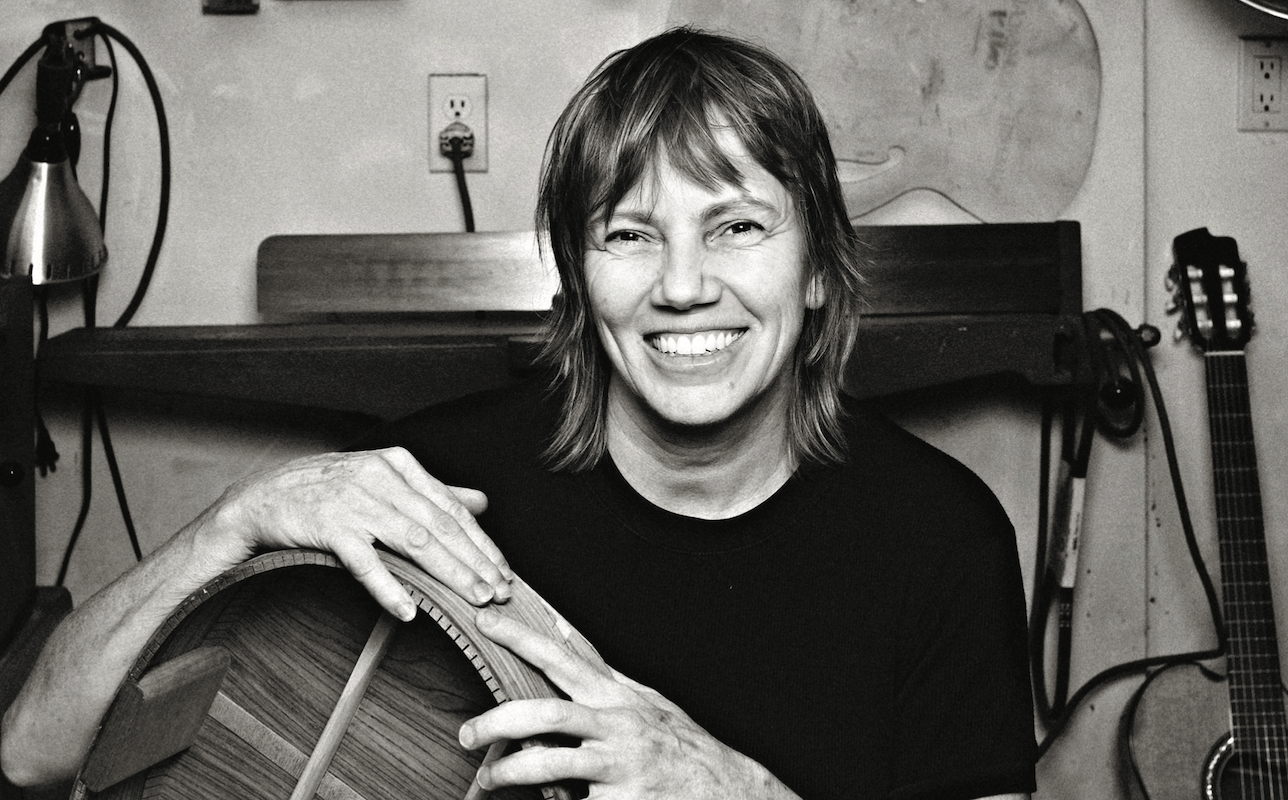
Innovative master luthier Linda Manzer reflects on her unique journey from artist and folk musician to world-renowned guitar maker
By Rob Lutes
Where were you born, and where did you grow up?
I was born in Toronto, and I grew up in Etobicoke. Toronto was not developed very much at that time, so there was wilderness all around me. My brother and I used to take our bikes out and ride around on the farms and stuff like that.
Was there anything in your youth that hinted at the path your career would take?
My dad worked in radar during the war, so he was very interested in electronics, and he fixed televisions in his spare time. He was quite handy. He had a radio and a workbench with lights that he worked at in the basement. I always remember that that was his happy spot. I set up a bench on the other side of the basement and started painting, and that was my happy spot. So that was kind of the seed of what this has turned into, perhaps.
Were you into music?
Yeah, I was. My mother was British, so I went to England quite a few times when I was a kid, and I was introduced to the Beatles before they were famous in Canada. I was telling my friends about this great group. So I feel like I personally discovered the Beatles for Canada. I started playing guitar, and that morphed into my interest in folk music.
I went to see Joni Mitchell perform at the Mariposa Folk Festival on Toronto Island. She was playing a dulcimer, and I was quite interested in the instrument. So I went to the Toronto Folklore Centre to see if I could buy one; it was $150, and I didn’t have that kind of money. The fellow who owned the shop said, “Well, you could buy a kit for half the price and assemble it yourself.” And I said, “I wouldn’t be able to do that.” And he said, “Of course you can.” We argued about it, and he won the argument. I bought the kit, and I made my first musical instrument.
And were you empowered by this creation?
Yes. The moment I put the strings on it, there was this magic moment in my life: “I created this, and it’s alive.” And then this thing goes on to create something else: music. But folk music was just sort of a fun thing for me to do; I was actually interested in painting. I went to Sheridan College, and there was a woodworking shop there where you could go and make the canvases for your paintings. I ended up making about 20 dulcimers there and teaching people how to make them.
Then I went to Halifax to go to the Nova Scotia College of Art and Design, and I kept ending up in the woodworking shop. I made a lyre, a triangular harp instrument that was non-fretted. And that’s when I decided to focus. I was an okay painter; I was not a great folk musician. But I was fascinated with making these musical instruments. So that’s when I started my hunt for somebody to apprentice with.
You ended up with the noted Canadian guitar maker Jean Larrivée.
His name kept coming up. One of my jobs in Halifax was as a telephone operator, so I knew how to operate a switchboard. I was able to call Larrivée in Toronto repeatedly for free. I just kept calling him until he hired me. And I was his apprentice for three and a half years.
And you advanced in the craft?
I went from knowing zero—no knowledge of power tools or anything and doing menial jobs—to being kind of his premier apprentice. And there was a sense of community with the apprentices in the shop—we were a family.
Following that, I opened up my own shop, which I shared for a couple of years with a guy who made lutes by hand. It was above a pool hall on College Street in Toronto. So I’d gone from this incredibly-well-equipped modern shop with Larrivée to a shop where a guy just used chisels and did everything by hand. I had to adapt, but it was a really good transition for me.
You’ve made some extremely innovative guitars, with multiple necks and many strings. But they all play beautifully. How do you make sure they remain in balance?
To be safe, I overbuild. The most important part structurally is the frame, so you make sure that the frame and the neck and the back are solid. But then when you make the top—the most important part of a guitar for sound—you make it as sensitive as you dare but as structurally sound as it needs to be. There’s a balance.
Is there a particular builder who inspires you today?
You know, the guitar-making community is quite special because we all work in our shops by ourselves, but when we do talk to one another, instead of competing, we’re actually sharing information because we want to advance the art and we want to learn. We love hanging out with one another and talking. If you ever go to a guitar show, you’ll find all the guitar makers in a corner of the bar talking about wood. [Laughs.] I could list you probably 50 builders who are people I have huge respect for—for their work and for them as people. I know I’m well known and everything, but I somehow feel like I’m in their shadow.
You’ve been doing this for a while.
I’m in my 51st year as a full-time professional builder.
How do you view this work as you age? Has your approach changed?
I kind of feel like I know the most and am the best at what I’m doing now. But I am aging. I’m more tired working because what I do is really, really physical labour. I’m hauling stuff and lifting and cutting, and you have to have real control of your body, because when you’ve got something you’ve been working on and you have to push it into a polishing machine, if you don’t hold it really tight, it flies across the room and smashes.
So my body is my most important tool. And I think that what I do has kept me younger physically. I think I’m in pretty good shape for my age, right? But the computer in here [points to her head] has 50 years of experimentation and failures and successes. And I’m still really curious. The other thing is that I love what I do. I love coming into the shop every day.
How many guitars do you build each year?
I would say eight to 10.
What’s the most exciting point in the building process?
There are a couple of highlights, but when the body gets assembled, when the top and the back are glued on, the guitar is basically built at that point. There’s still lots of work to do, but that means I’ve already sealed its fate, so I can relax a little bit. The other moment is when I’ve put the guitar in the box and left it at the shipping place and I walk out the door. There’s this weight lifted off me, because now it’s about to go on a journey to its owner. And the other highlight is when the person walks onstage and plays it.
When you build a guitar, does the work ever become spiritual for you?
It does. It’s almost an unconscious thing, but I do actually feel as if there is a little bit of spirit in each instrument. I mean, music is magic. It’s this thing that touches people and touches your soul, and it’s universal. No matter what language comes out of your mouth, the musical language speaks to everyone. I’ve seen complete strangers at guitar shows who’ve never said a word to each other, but they start playing music together. I saw this happen once when they played for an hour and then at the end of the hour, they looked up with big smiles on their faces. They’d been talking with those two guitars, and then they shook hands and introduced themselves.
You’ve made guitars for many well-known players, including Gordon Lightfoot, Bruce Cockburn, and Carlos Santana, but you’re most connected to the jazz guitarist Pat Metheny. How did he come to play so many of your instruments?
I first saw him when he was playing with Joni Mitchell’s band. Pat did a solo in the song “Hejira”—it was an outdoor concert, and I was in the grass. All of a sudden, when Pat started playing, my brainwaves switched and the audience disappeared and all I could hear was him. The music touched my soul so deeply. I went out and bought every record he had after that, and I became a huge fan.
When he was coming to Toronto, I wrote a note to be given to him backstage. At that time, I had a Danish apprentice, Peter, who read the note and said: “This is too generic. Write it from your heart.” So I rewrote it, and that’s the letter that Pat got. He invited me to come backstage after the concert, and I met him and we exchanged phone numbers. And then Danny Gottlieb, Pat’s drummer, said, “Why don’t we go back to the hotel?” Pat and I looked at each other and…. Pat doesn’t do this—I found out later he never does it—but he said, “Sure.” So I ran home— well, I didn’t even live anywhere; I had a shop, but I was sleeping on people’s couches. I grabbed two guitars from my shop and went to the hotel. And the four of us sat in Pat’s room until three in the morning. Pat sat on his bed and kind of replayed the whole concert on my two guitars. And then he said, “I’d like one.” That was the beginning. And we’re at, like, 26 or 27 guitars now.